

• 232 NE Middlefield Rd, Portland, OR 97211

Star Oilco

Star Oilco technician testing off-road diesel fuel quality with a funnel and filter on-site in Portland OR
Dyed Diesel Delivery in Portland, Oregon 1024 768 Star Oilco

Dyed Diesel Delivery in Portland, Oregon

Need dyed diesel delivered in Portland?

Star Oilco delivers dyed diesel, also called off-road diesel or red diesel, directly to businesses, construction sites, equipment, generators, and bulk fuel tanks throughout the Portland metro area.

Whether you need a one-time delivery for a project or regularly scheduled fuel service, we can help keep diesel where you need it and keep your equipment running.

Star Oilco fuel tanker delivering diesel to a CES Power mobile generator unit in a commercial lot

If your equipment is operating off public roads or qualifies for another nontaxable use, dyed diesel may be the right fuel for your operation.

Instead of sending employees offsite to find fuel, Star Oilco can bring it directly to you.

We provide dyed diesel delivery for:

Construction sites | Excavators and heavy equipment | Generators | Industrial equipment | Pumps and compressors | Agricultural equipment | Refrigerated equipment | Bulk fuel tanks | Commercial facilities | Temporary projects | Long-term operations

Our goal is simple. You should not have to stop working because you are waiting on fuel.

Dyed Diesel Delivered Directly to Your Jobsite

Construction sites are one of the most common places we deliver dyed diesel. Heavy equipment can burn through fuel quickly, and sending operators offsite to refuel is rarely the most efficient option. Star Oilco can deliver fuel directly to your project so excavators, loaders, skid steers, generators, and other equipment stay fueled without leaving the site.

We can provide:
Direct-to-equipment fueling, Bulk dyed diesel delivery, Onsite fuel tanks, Scheduled deliveries, Keep-full service, Weekend fueling, Generator fueling, DEF delivery

For projects running long hours or seven days a week, scheduled fuel delivery can help prevent downtime and make fuel one less thing for your project manager to worry about.

Direct-to-Equipment Dyed Diesel Fueling

Not every jobsite needs a storage tank. Sometimes it makes more sense for the fuel truck to come directly to the equipment. Star Oilco offers mobile onsite fueling for projects where equipment needs to be fueled in place.

This can be especially useful for:

Excavators | Loaders | Dozers | Cranes | Generators | Compressors | Light towers | Heaters | Other equipment that stays onsite

Instead of moving your equipment to the fuel, we bring the fuel to the equipment. That means less time spent fueling and more time spent working.

Bulk Dyed Diesel Delivery in Portland

If your business already has a fuel tank, Star Oilco can deliver dyed diesel directly into your storage system.

Bulk delivery can make sense for companies that use fuel regularly and want diesel available whenever equipment needs it.

Businesses commonly use bulk dyed diesel for:

Construction yards | Equipment fleets | Manufacturing facilities | Industrial operations | Farms | Generator systems | Long-term construction projects | Equipment rental operations

Delivery frequency can be set around the way your business actually uses fuel. Some customers only need occasional deliveries. Others need scheduled deliveries several times per week.

Need a Dyed Diesel Tank for Your Project?

If you need fuel onsite but do not already have a storage tank, talk with Star Oilco about your options.

For qualifying construction projects and commercial customers, we can help determine an appropriate tank setup based on your fuel usage and delivery schedule.

An onsite tank can be a good fit when:

  • Equipment runs every day
  • The project will last several weeks or months
  • Multiple machines need fuel
  • Fuel stations are not conveniently located
  • Crews work early mornings, nights, or weekends
  • You want more control over your fuel supply

Instead of ordering fuel every time a machine gets low, your operators can fuel directly from the tank.

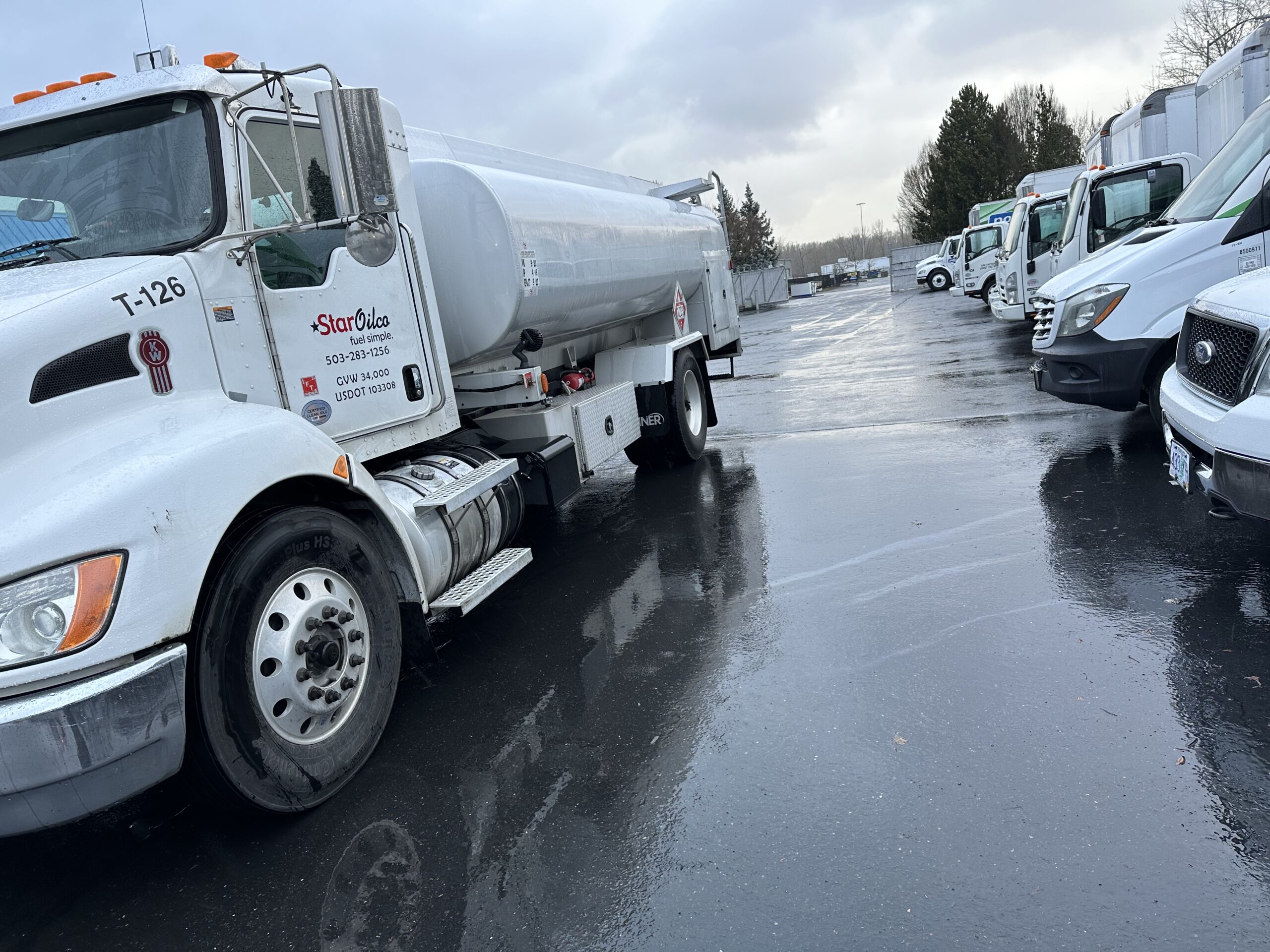
Star Oilco white fuel delivery truck parked in a lot under wet pavement

Ready to set up an onsite fuel tank for your project?

Never run dry on the jobsite

Star Oilco provides automatic refilling and scheduled off-road diesel deliveries throughout Portland.

Scheduled and Keep-Full Dyed Diesel Delivery

Running out of fuel is expensive.

If your excavator, generator, loader, or other critical equipment runs dry, the impact can spread quickly across the rest of the operation.

That is why many Star Oilco customers use scheduled or keep-full delivery.

Rather than waiting until someone notices the tank is almost empty, deliveries can be planned around expected fuel usage.

Depending on your operation, that might mean:

  • Weekly delivery
  • Multiple deliveries per week
  • Regular project schedules
  • Start-of-shift fueling
  • End-of-shift fueling
  • Weekend service
  • Fueling for equipment operating around the clock

Star Oilco provides construction fueling service seven days a week in the Portland metro area for projects that need consistent fuel supply.

WHY PORTLAND BUSINESSES CHOOSE LOCAL FUEL DELIVERY

Getting fuel from a retail station may work when you only need a few gallons.

It becomes much less practical when your business is operating heavy equipment or consuming hundreds of gallons of diesel.

Onsite fuel delivery can help reduce:

  • Employee trips to fuel stations
  • Equipment downtime
  • Time spent transporting fuel
  • Fuel shortages
  • Last-minute fuel runs
  • Project delays caused by empty equipment

It also gives you a more predictable way to manage fuel across a project or facility.

Star Oilco has been serving Portland-area fuel customers for generations and provides bulk fuel, onsite fueling, cardlock, construction fueling, and commercial diesel services throughout the region.

Call Star Oilco at 503-283-1256

How Much Dyed Diesel Can You Have Delivered?

The right delivery size depends on your operation. A contractor with a few machines may have very different needs than a large industrial facility or major construction project.

When you contact Star Oilco, it helps to know:

Your delivery location | Type of equipment | Approximate gallons needed | Whether you have a tank | Tank capacity | How often you expect to need fuel | Site access restrictions | Whether you need DEF | Whether you need renewable diesel or another fuel specification

Construction site scene with a Star Oilco fuel tanker and a worker in a safety vest connecting a red hose to a large excavator nearby.

If you do not know your exact fuel usage, that is fine. We can talk through what you are running and help determine an appropriate delivery plan.

Two workers shake hands at a construction site beside a Star Oilco fuel truck and equipment in the background.

How Quickly Can I Get Dyed Diesel Delivered?

Delivery availability depends on location, fuel volume, current scheduling, and the type of service required.

If you have an upcoming project, it is always better to arrange fueling before the equipment arrives.

For regular customers, scheduled fuel delivery can also reduce the need for last-minute orders.

If you need fuel now, Call Star Oilco and tell us where you are located, how much fuel you need, and what you are fueling.

Where Does Star Oilco Deliver Dyed Diesel?

Star Oilco is based in Portland and provides commercial fuel delivery throughout the Portland metro area and surrounding Northwest Oregon markets.

We also serve customers in the greater Portland and Vancouver region.

If you are unsure whether your location is within our delivery area, call us with the jobsite or business address.

How Much Does Dyed Diesel Delivery Cost in Portland?

Dyed diesel pricing changes with the fuel market.

The delivered cost can also depend on:

Number of gallons ordered | Delivery location | Delivery frequency | Fuel product | Site access | Tank setup | Additional services

For an accurate delivered price, contact Star Oilco for a current quote.

If you use fuel regularly, we can also discuss scheduled delivery rather than treating every order as a one-time fuel purchase.

Is Dyed Diesel Cheaper Than Highway Diesel?

Dyed diesel is generally less expensive for qualifying uses because certain highway-related fuel taxes do not apply in the same way they do to taxable highway fuel.

The exact price difference changes with the market.

For businesses running equipment every day, however, using the correct off-road fuel can make a meaningful difference in overall fuel costs.

Dyed diesel should only be used for qualifying purposes.

If you are unsure whether your equipment can legally use it, see our guide to Oregon dyed diesel laws.

WHY BUY DYED DIESEL FROM STAR OILCO?

Fuel is rarely the most exciting part of running a construction project or commercial operation.

But when you do not have it, everything stops.

That is why our focus is making fuel simple.

Star Oilco provides Portland businesses with:

Local dyed diesel delivery | Bulk fuel delivery | Direct-to-equipment fueling | Onsite fuel tanks | Scheduled and keep-full service | Seven-day construction fueling | Tight-access fueling options | DEF delivery | Renewable diesel | Biodiesel | Clear diesel | Commercial fueling support

Whether you need one delivery or ongoing fuel service, we can build the delivery schedule around the way your operation works.

Get Dyed Diesel Delivered in Portland

If you need dyed diesel delivery in Portland, tell us where the fuel needs to go, what you are fueling, and approximately how much you need.

We can help determine whether direct-to-equipment fueling, bulk delivery, or an onsite fuel tank makes the most sense.Call Star Oilco at 503-283-1256

Serving commercial, construction, industrial, and equipment customers throughout the Portland metro area and surrounding Northwest Oregon.

Dyed diesel is intended for qualifying nontaxable uses. Whether a particular vehicle or piece of equipment qualifies depends on how it is being used. Consult current Oregon Department of Transportation guidance for specific fuel-tax questions.

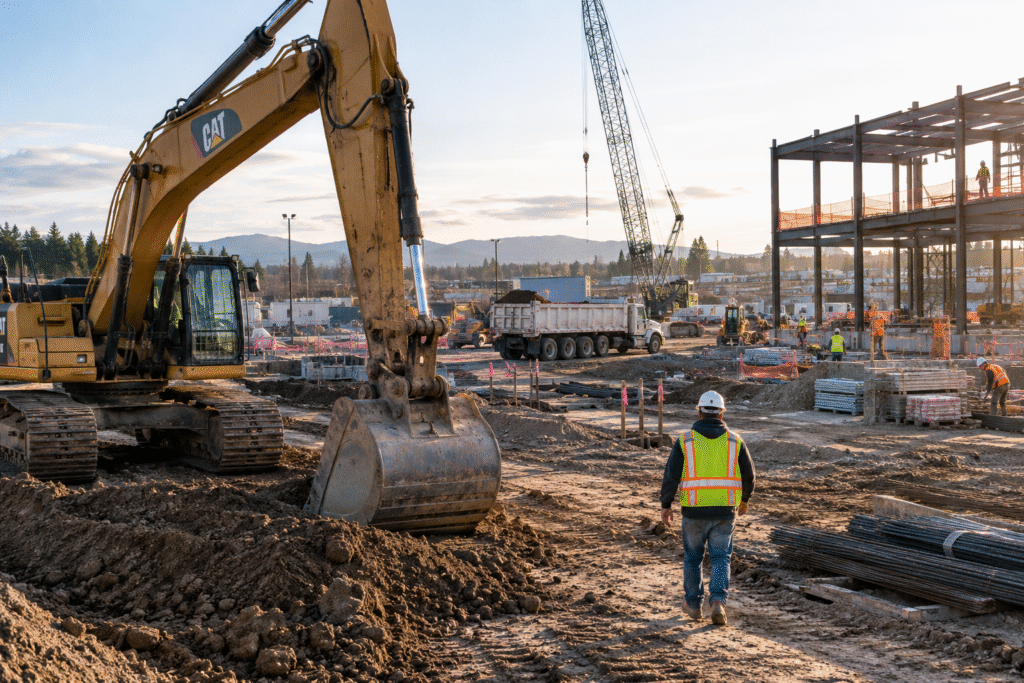
Excavator, bulldozer and dump truck at a construction site
Dyed Diesel for Construction Equipment 1024 576 Star Oilco

Dyed Diesel for Construction Equipment

Construction equipment burns a lot of diesel.

Excavators, loaders, dozers, generators, cranes, skid steers, and other heavy equipment can run for hours every day. If that equipment is operating off public roads, dyed diesel may be the right fuel for the job.

Also called off-road diesel or red diesel, dyed diesel is commonly used to fuel qualifying construction equipment because it is intended for off-road and other nontaxable uses.

For contractors, that can mean a more cost-effective way to keep equipment running without sending operators offsite to find fuel.

Star Oilco delivers dyed diesel directly to construction sites throughout the Portland area and Northwest Oregon.

What Is Dyed Diesel for Construction?

Dyed diesel is diesel fuel that contains a red dye identifying it for qualifying nontaxable uses.

On a construction site, it is commonly used in equipment that operates off public roads.

That can include:

Excavators | Bulldozers | Wheel loaders | Skid steers | Backhoes | Cranes | Pavers | Trenchers | Compactors | Compressors | Generators | Pumps | Other off-road construction equipment

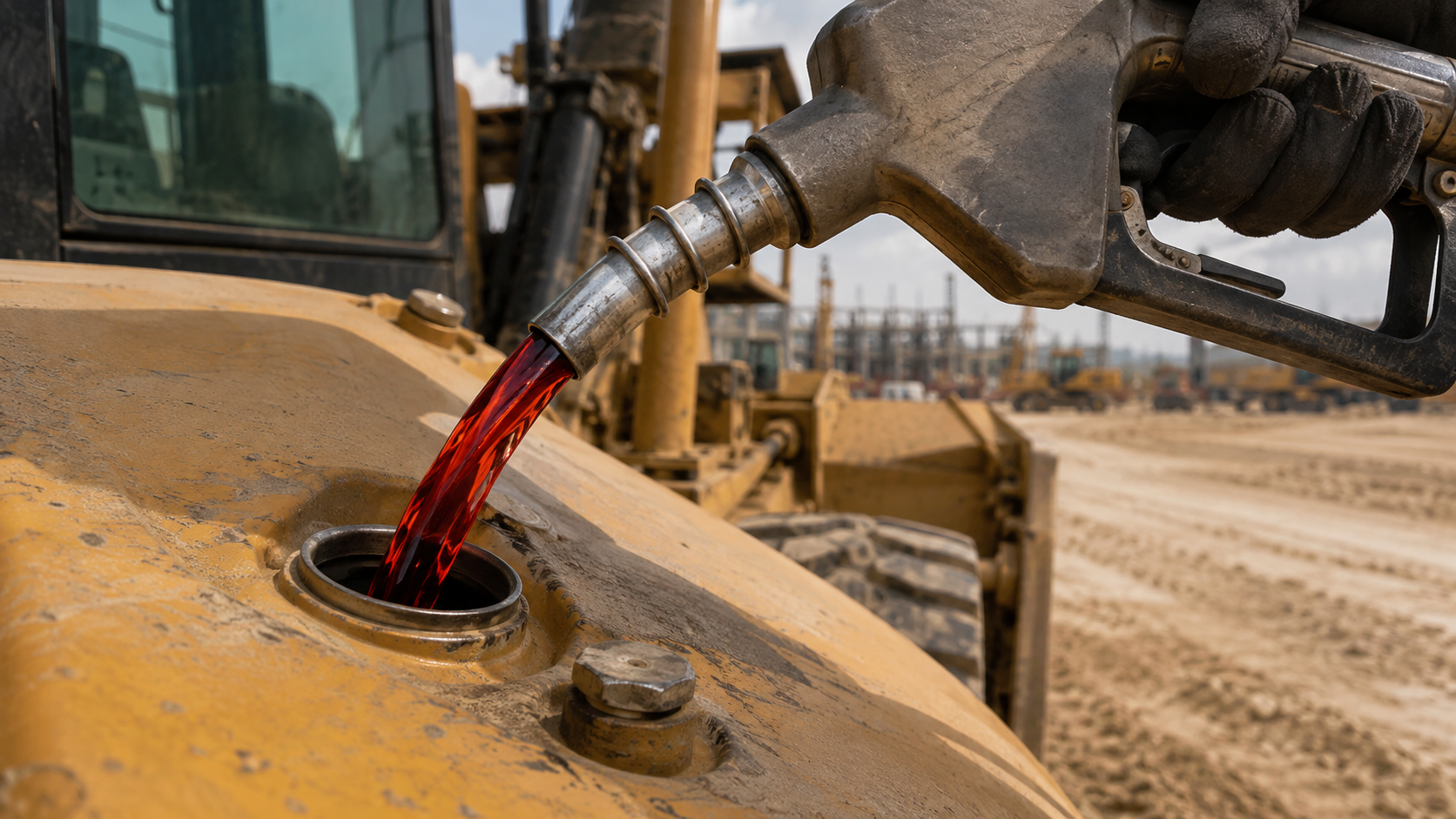
Red dyed diesel fuel pouring from a fuel nozzle

The fuel itself is dyed so it can be distinguished from clear diesel used in highway vehicles. For a contractor, the important question is not whether the equipment has a diesel engine. The important question is how that equipment is being used.

Can Dyed Diesel Be Delivered Directly to Construction Equipment?

Yes.

One option is direct-to-equipment fueling, sometimes called wet hosing. With this type of service, a fuel truck comes to the project and fuels equipment directly. Instead of operators bringing equipment to the fuel, the fuel comes to the equipment. This can work well for projects with multiple machines spread around a site or equipment that is difficult to move.

Depending on the project schedule, fueling can also be coordinated around shifts so equipment is ready when crews arrive.

Red dyed diesel being pumped into heavy construction equipment

What Construction Equipment Can Use Dyed Diesel?

Many pieces of heavy equipment spend their entire working life on jobsites rather than public highways. Those are the types of machines where dyed diesel is commonly used.

An excavator digging foundations, a loader moving material around a site, or a generator supplying temporary power are all typical examples.

Equipment that regularly travels on public roads is different.

For example:

Excavator working on the jobsite: Dyed diesel may be appropriate.

Skid steer working around the site: Dyed diesel may be appropriate.

Generator powering the project: Dyed diesel may be appropriate.

Pickup truck driving employees to the project: Clear highway diesel should be used.

Dump truck traveling public roads: Highway fuel rules apply.

It is common for a construction company to need both dyed diesel and clear diesel on the same project.

Excavator and heavy construction equipment working on a jobsite where dyed diesel may be used

Why Do Contractors Use Dyed Diesel?

There are a few reasons dyed diesel makes sense for qualifying construction equipment.

Lower Fuel Cost

Dyed diesel is generally less expensive than highway diesel because certain highway-related fuel taxes do not apply when the fuel is used for a qualifying purpose.

When a project is running several pieces of heavy equipment every day, even a relatively small difference in fuel cost can become meaningful.

Convenient Onsite Fueling

Fueling heavy equipment at a gas station is usually not practical.

Instead, dyed diesel can be delivered directly to the jobsite.

That allows contractors to keep fuel where the equipment is actually working.

Less Equipment Downtime

Sending employees offsite for fuel takes time.

It can also mean transporting fuel in smaller quantities, coordinating drivers, and interrupting work during the day.

Having fuel delivered to the site helps keep equipment running and operators focused on the project.

Better Fuel Planning

Larger projects can burn through diesel quickly.

Scheduled fuel delivery makes it easier to plan around the amount of equipment running, expected hours of operation, and upcoming phases of the project.

Can I Put a Dyed Diesel Tank on a Construction Site?

For many construction projects, an onsite fuel tank is the simplest option.

Instead of fueling every machine directly from a delivery truck, Star Oilco can deliver dyed diesel into a tank located at the project.

Your operators can then fuel equipment as needed.

An onsite tank can be especially useful when:

  • A project will run for several weeks or months
  • Multiple machines are using diesel every day
  • Equipment operates long shifts
  • The site is far from convenient fueling locations
  • Fuel needs to be available early in the morning or after normal business hours

The right tank size depends on how much fuel your equipment burns and how frequently you want deliveries.

Star Oilco can help determine what type of fueling setup makes sense for the project.

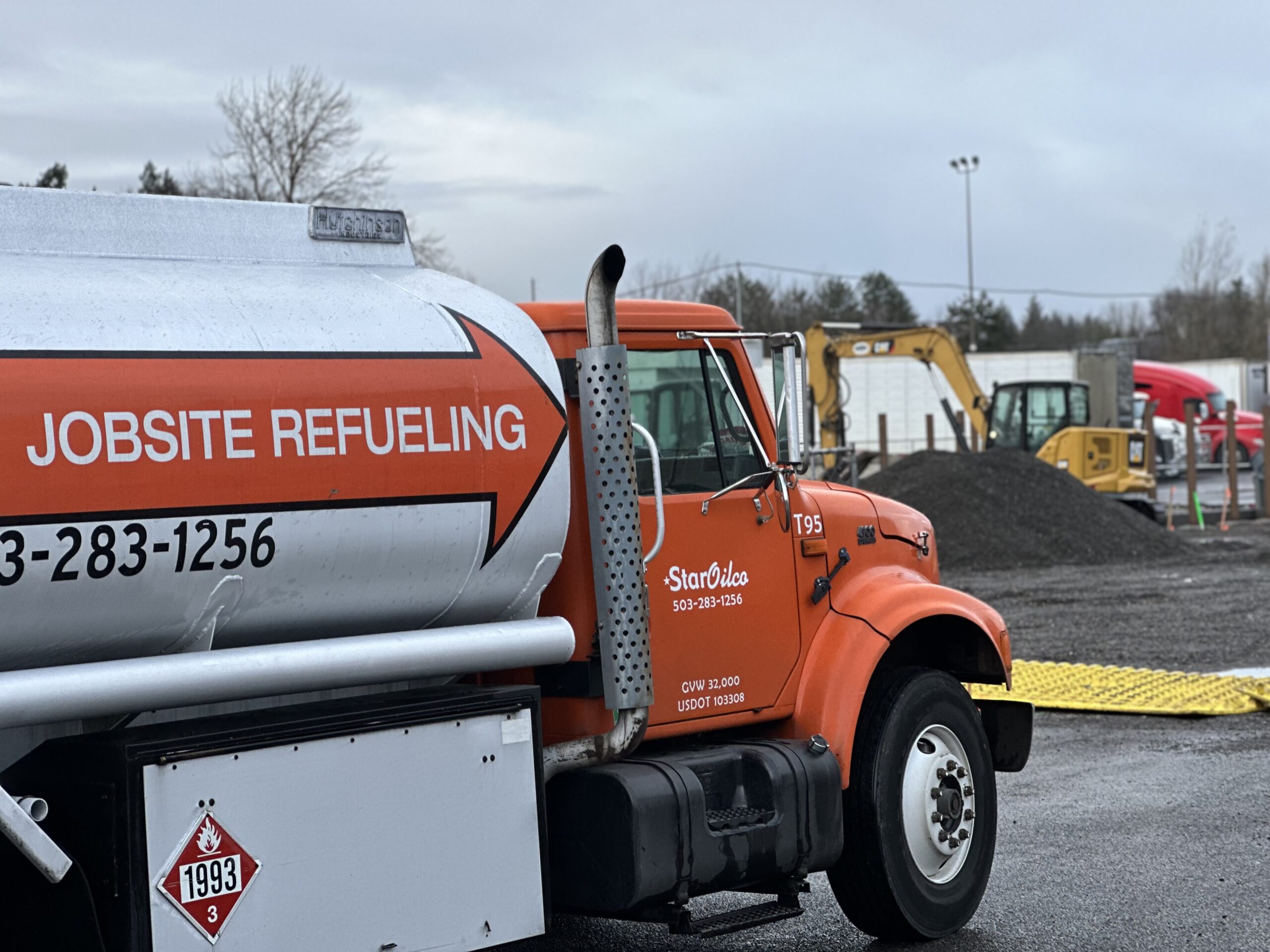
Star Oilco jobsite refueling truck at a construction site

contact us today to deliver on your site

How Much Dyed Diesel Does a Construction Site Need?

There is no single answer because every project is different.

A small excavation project with a skid steer and mini excavator may use a relatively modest amount of fuel.

A large site running excavators, loaders, dozers, generators, cranes, and other equipment can use hundreds or even thousands of gallons over the course of a project.

A useful way to estimate your fuel needs is to look at:

  • Number of diesel-powered machines
  • Equipment fuel tank sizes
  • Expected operating hours per day
  • Number of workdays per week
  • Generator runtime
  • Project duration
  • Expected changes in equipment during different project phases

If you are not sure how much fuel you will need, your fuel supplier can help estimate delivery volume and frequency.

Dyed Diesel Delivery vs. Fueling Equipment Yourself

Some contractors start a project by sending employees to pick up fuel in portable tanks.

That can work for a very small job, but it becomes inefficient as fuel usage increases.

Consider the time involved in:

  • Driving to get fuel
  • Waiting at a fueling location
  • Transporting the fuel back to the jobsite
  • Moving fuel around the site
  • Tracking who is responsible for refueling
  • Stopping equipment when fuel runs low

For larger projects, bulk delivery or direct-to-equipment fueling can remove much of that work.

The goal is simple. Keep the equipment operating and keep your employees working on the project instead of making fuel runs.

Is Dyed Diesel Different From Regular Diesel?

The biggest visible difference is the red dye.

The dye identifies fuel intended for qualifying nontaxable use.

Federal fuel-tax rules provide for dyed diesel fuel used for qualifying nontaxable purposes.

There can also be different diesel products available depending on your project and equipment.

Star Oilco can supply construction projects with fuel options that include:

  • Dyed ULSD
  • Biodiesel blends
  • Dyed renewable diesel
  • Clear highway diesel
  • Gasoline
  • Other fuels required for specific project needs

The right product depends on your equipment, project requirements, and fuel specifications.

Can You Use Dyed Diesel in Construction Trucks?

This is an important distinction.

Just because a truck is owned by a construction company does not mean it can use dyed diesel.

Oregon treats diesel used to propel vehicles on public roads as taxable use fuel.

That means normal highway vehicles should not be filled with dyed diesel just because they are being used for construction work.

Examples include:

  • Pickup trucks
  • Service trucks
  • Delivery vehicles
  • Highway dump trucks
  • Other vehicles regularly driven on public roads

A construction site may therefore have dyed diesel for heavy equipment and clear diesel for highway vehicles.

If you are unsure which fuel belongs in a particular piece of equipment, check the current Oregon fuel rules before fueling it.

Can Dyed Diesel Be Delivered Directly to Construction Equipment?

Yes.

One option is direct-to-equipment fueling, sometimes called wet hosing. With this type of service, a fuel truck comes to the project and fuels equipment directly. Instead of operators bringing equipment to the fuel, the fuel comes to the equipment. This can work well for projects with multiple machines spread around a site or equipment that is difficult to move.

Depending on the project schedule, fueling can also be coordinated around shifts so equipment is ready when crews arrive.

How Should You Store Dyed Diesel on a Construction Site?

Fuel storage should be planned before the tank arrives.

A jobsite fuel tank should be located where delivery trucks can safely access it and where equipment operators can fuel without interfering with normal site operations.

The exact requirements will depend on the tank, site, project, and applicable safety or environmental rules.

In general, contractors should think about:

  • Delivery truck access
  • Equipment access
  • Tank protection
  • Spill prevention
  • Fuel security
  • Clear labeling
  • Keeping dyed and clear diesel separate
  • Who is authorized to dispense fuel

A little planning at the beginning of a project can make fueling much easier for the rest of the job.

How Often Should a Construction Site Get Fuel Delivered?

Delivery frequency depends on how quickly the project uses fuel.

Some projects may only need occasional deliveries.

Busy jobsites may need fuel several times per week or on a regular scheduled route.

The best approach is to avoid running the tank too low before ordering fuel.

If your crew waits until the tank is nearly empty, a delayed delivery can quickly turn into equipment downtime.

Scheduled or keep-full delivery can make fuel management easier by maintaining fuel onsite based on the project’s expected usage.

What Happens If a Construction Project Runs Out of Diesel?

Running out of fuel can affect more than one machine.

If a loader, excavator, generator, or other important piece of equipment runs dry, other parts of the project can slow down while crews wait for fuel. That is why fuel planning should be treated like any other jobsite supply.

Contractors already schedule concrete, materials, equipment, dumpsters, and subcontractors.

Fuel should be planned the same way.

Knowing your average daily usage and setting a reorder point can help prevent unnecessary downtime.

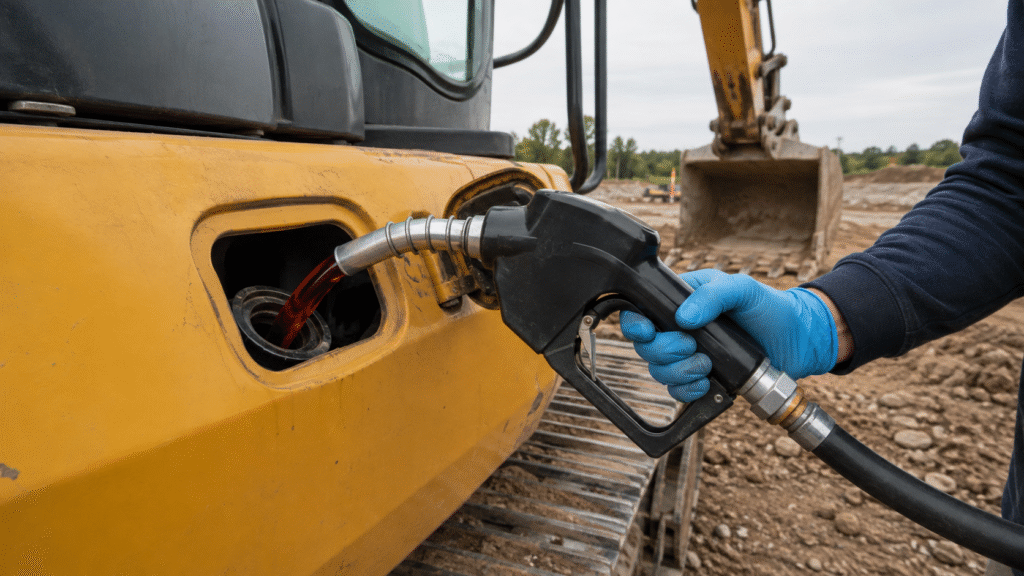
Worker refueling a yellow excavator with dyed diesel at a construction site

Dyed Diesel Delivery for Portland Construction Sites

Star Oilco provides construction fuel delivery throughout the Portland metro area and surrounding parts of Northwest Oregon. We can deliver dyed diesel directly to equipment or provide fuel for an onsite construction tank.

Depending on the project, we can help with:
Dyed diesel delivery | Direct-to-equipment fueling | Construction fuel tanks | Scheduled fuel delivery | Keep-full fueling | Clear diesel | Renewable diesel | Biodiesel blends | Generator fuel | Gasoline | DEF and other project fueling needs

Whether you are running one excavator or managing fuel for a large construction project, the goal is the same.

Keep your equipment fueled so your crews can keep working.

Need Dyed Diesel for a Construction Project?

Tell Star Oilco what equipment you are running, where the project is located, and approximately how much fuel you expect to use.

We can help determine whether direct fueling, an onsite tank, or scheduled bulk delivery makes the most sense for your project.

Call Star Oilco at 503-283-1256

Questions about whether a specific vehicle or piece of equipment qualifies for dyed diesel can depend on how it is being used. For questions about Oregon fuel-tax requirements, consult current Oregon Department of Transportation guidance or a qualified tax professional.

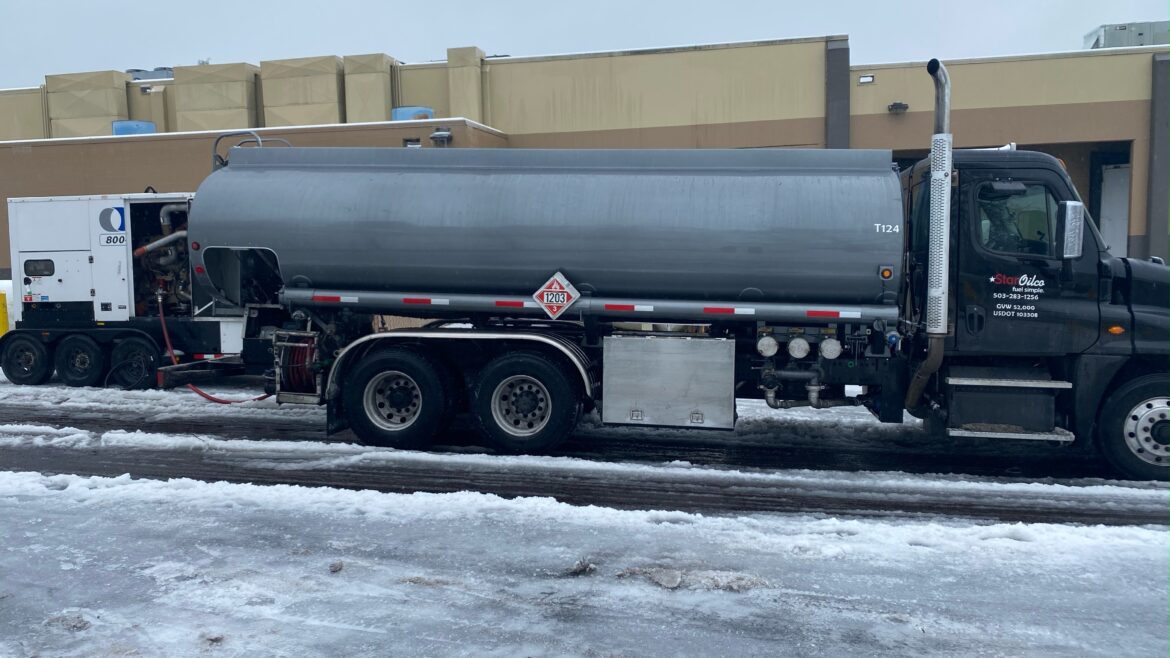
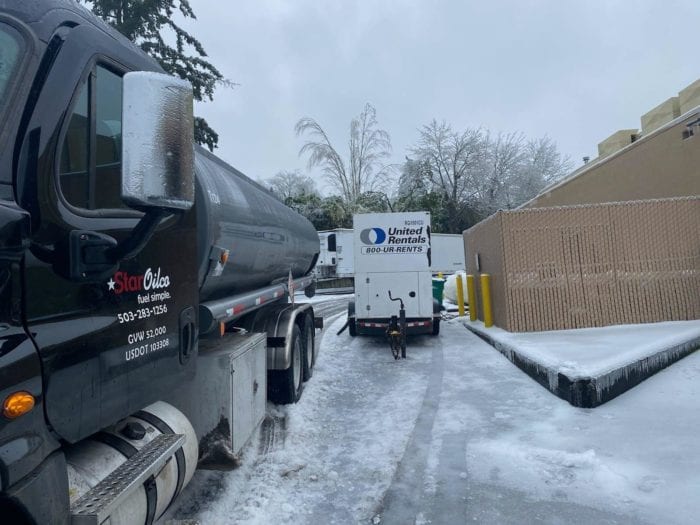
Star Oilco fuel tanker truck delivering diesel to refrigeration unit during icy winter conditions
Do you need Refrigerated Trailer fuel? We fuel reefers automatically. 1024 768 Star Oilco

Do you need Refrigerated Trailer fuel? We fuel reefers automatically.

Refrigerated Trailer Fueling Service.

Dyed Diesel delivered to your trailer.

Need to keep your refrigerated trailer running during the summer heat in the Pacific Northwest? When temperatures rise, having a reliable reefer trailer is more important than ever to protect your inventory. That’s where Star Oilco comes in. Our team provides fast, dependable refrigerated trailer fuel delivery in Portland, Salem, Vancouver, and nearby areas. We’ll keep your cold storage trailers fueled and your goods safe, so you can focus on your business, not the weather.

Keep your refrigerated trailer running with our automatic keep full program.

Reefer trailer fuel service

Refrigerated trailers, often also called “reefers” in trucking.  These are popular in grocers, food processors, and many other industries. Reefers expand refrigerated inventory for grocers during the food rush of the holidays, and Star Oilco is ready to keep your inventory cold.

Star Oilco is the Portland area’s leading refueler of refrigerated trailers. We’re ready to help you expand your on hand inventory by supplying dyed diesel for your refrigerated trucks. We have the industry’s lowest price for service, a flat fee of $65 for service on an automatic keep full schedule. We’ll keep your inventory the right temperature this holiday season! Our trucks are ready and on the road driving past your location. This program is designed specifically in response to grocers and food processors needing a partner to simplify their refrigeration needs during their busiest time of year.

We make it one less thing to worry about.

How often should you fuel your refrigeration trailer?

Reefer Trailers typically can run for two days without a refuel if opened only once or twice a day.  Three days if you go a weekend without opening the trailer if fueled on Friday.  If you have staff leaving the door open regularly expect to need fuel daily.

Refrigerated trailer fueling. Keep full program.

Call for service. The first step is to open an account or run the service on a credit card, fleet card, or other payment method used by your business. 

Star Oilco can provide either Ultra Low Sulfer B5 Diesel, or low CO2 R99 Renewable Diesel to your reefer. All fuels are dyed and for off-road use to avoid the expensive taxes associated with using clear diesel from a gas station pump. All of our dyed diesel is treated with Hydrotex PowerKleen Premium Diesel. This additive guarantees long-term storage stability and improves performance at time of combustion.

A refrigerated trailer typically burns between 10 and 15 gallons a day in the Portland area during the winter. In our experience, fuel burns faster if the door is continually opened. Some customers are able to get by with service twice a week. Given this experience, we usually recommend a refill schedule of three days a week. This ensures you have no downtime or worry with the refrigerated trailer.

Customers on automatic keep full schedule receive emergency response services for fuel theft at no additional charge. We will be there for you to make running your business that much easier.

Also remember if you are storing a trailer onsite for back up or overflow purposes you will want to prepare the fuel in the tank for long term storage. Star Oilco’s fuel additives ensure the storage and make sure your refrigerated trailer fires when you need it to.

To set up Refrigerated Trailer Refueling Service call or email our office.

We are ready to keep you full.

Construction equipment fuel delivery service

Message us below if you want to get a call back from our Dispatch about setting up service or call 503-283-1256 for immediate service.

Contact Form

  • This field is for validation purposes and should be left unchanged.
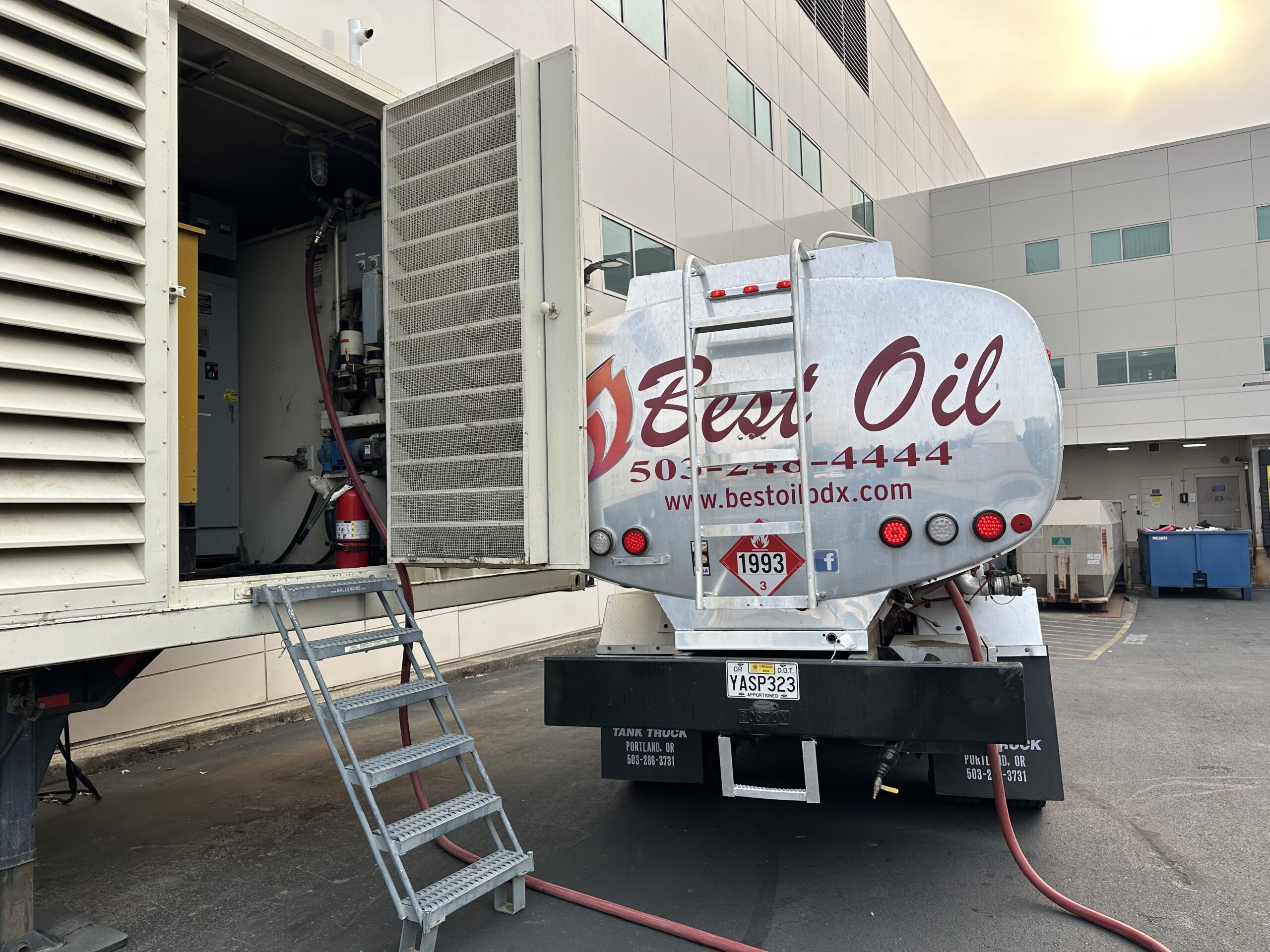
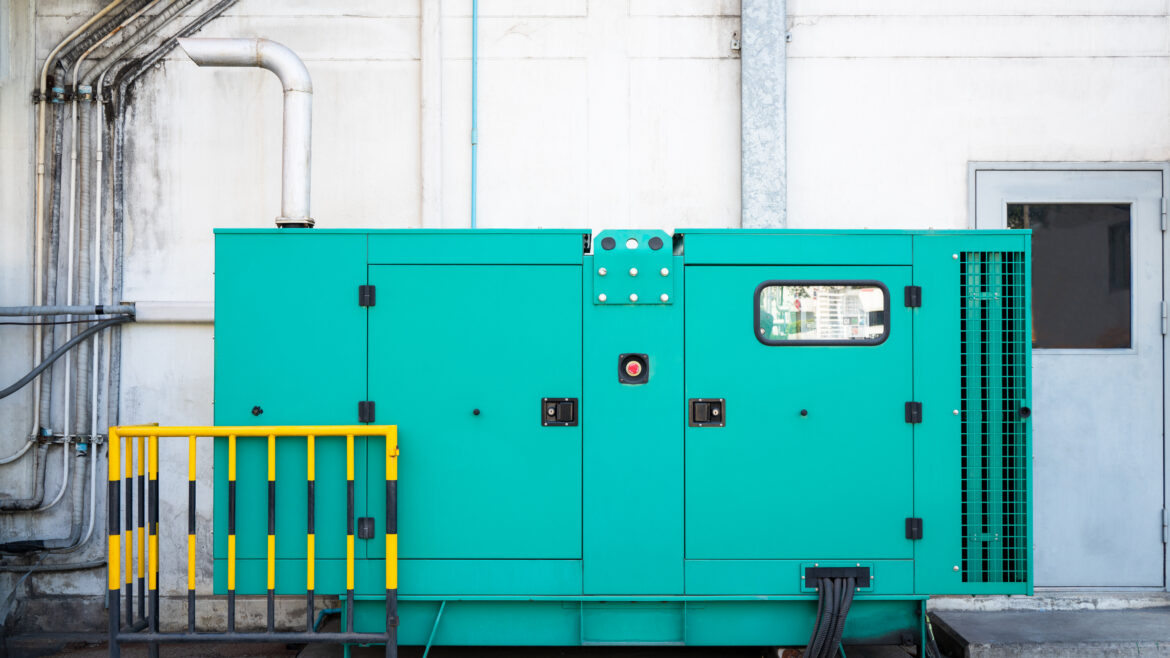
Industrial backup generator installed outside a commercial building
Emergency Back-up Diesel Fuel 1024 683 Star Oilco

Emergency Back-up Diesel Fuel

In an emergency, how often will your Emergency Back-up Diesel Fuel tank need to be filled?

We deliver dyed diesel seven days a week and will keep your equipment full for you.

Emergency Back-up diesel fuel delivered in Portland, Oregon

What is the condition of your Emergency Back-up Diesel Fuel in your generator tank?
When the Power goes out, we have diesel ready to keep your backup generator fueled.  We can also set up automatic fueling and DEF top off service with confirmation for your facility team’s needs. Whether you want long term stabilized diesel, dyed R99 renewable diesel, or B20 biodiesel blends we have you covered with your fuel specification needs.

Emergency Back-up diesel fuel tank avaialble.

Star Oilco has 250 gallon and 500 gallon tanks available to increase the onsite supply for an emergency back-up diesel need in the Pacific Northwest.

We have drivers on the road today with diesel.

When was the last time you had your generator filled with stabilized diesel?  We deliver off road diesel treated for long term storage.

Open an account with Star Oilco today and prepare for the next power outage.

Recent heat waves might have caused power outages.  Make sure your generators are full for this winter now.  With dynamic changes in the way power is used in the Pacific Northwest power outages have become more common than ever before.


Are you prepared for the next emergency?
Have you filled up since the last time?
Would you want to test your diesel fuel oxidative stability to make sure it is still good?

Keeping your back-up generator fueled could be the difference between an inconvenience and a disaster.  Stay ahead of the next emergency and re-fuel now.


Remember that ordering diesel for your generator is a specialized service, we will make it easy for you.

Getting the fuel for your generator or emergency equipment is only one part of the problem.  How you store it can be just as important.  This is why its important to work with a company that can help you.

You want to stabilize and treat your diesel for generators and other back up equipment.

Order fuel treated for long term storage!

Star Oilco is an expert at fueling back-up generators, emergency water pumps, and other long term off-road diesel storage requirements. We understand, that in the Pacific Northwest, biodiesel blending is required by state laws. Biodiesel needs an extra layer of care when stored as a back-up diesel fuel.Filling a Generator in the Snow

Most off-road diesels and heating oils are ultra-low sulfur diesel containing at least 5% quantity of biodiesel.  This means long term storage requires a proactive approach.  You can’t just hope it works or wait to see if the fuel will burn after years of storage.

Emergency back-up generator diesel fuel is a specially treated oxidative stabilized off-road fuel designed to store for years.

Fueling a backup generator is a specialized product. The fueling service requires a vendor who understands your needs and keeps you up and running in an emergency.

Generators take off-road diesel, of course, but you want an ultra-low sulfur diesel to ensure it works with modern emission systems. Some companies deliver higher sulfur product that look the same but foul the emission systems of your equipment.

Beyond the service provided, you also want a vendor who offers a fuel stabilizer and biocide for the special long term storage needs of your backup generator. Star Oilco recommends you add a biocide and long-term storage stabilizer to your fuel to ensure it is good whenever you need it.

Use additives designed to prolong the life of your emergency diesel fuel.

Biocides prevent the growth of biological activity in the tank. In scenarios where micro-organisms like algae, bacteria, yeasts, and other bugs are growing in your fuel, biocides kill this growth. It is still important to remove the residual grit and other contaminants that are the hallmark of bugs growing in your tank. Usually, turning over the fuel or using a filtration can remove this.

If your tank absolutely has to be clean, you can contract a tank professional to enter the tank and physically clean the tank bottom or reline the tank with either fiberglass or an epoxy resin. We use Valvtect Bioguard Plus 6 for generators, emergency water pumps, backup boiler fuel, and other long term storage purposes. This product kills any existing biological growth and stabilizes your fresh diesel fuel for long term storage. Make sure your diesel is ready the next time you need backup power.

Water in diesel destroys fuel quality rapidly.

Check your tank for water every fall and spring.

Pumping the tank bottom removes water if it ever finds its way into your storage tank. Additionally, you want to put in an absorbent material designed to absorb water and not fuel. If your long-term storage tank has water and you are not planning to burn 100% of the fuel in the near future, DO NOT add anything that removes water by distributing into the fuel. Adding a “fuel drier” that actually pushes the water into solution with the diesel will worsen the long-term quality of your fuel, not improve it. That water is where bugs find their home to grow in fuel.

Star Oilco will test your fuel at no charge if you have an open account.

Feel free to call us with any questions you may have about long term storage of diesel. Star Oil can also deliver treated diesel ready for long term storage complete with Premium Diesel additive to improve the long-term storage quality of your fuel. For biocide, we use Valvtect BioGuard fuel microbiocide to kill any possible biological activity and prevent any chance of it starting.

Diesel Testing and Storage in Portland

If you have a long-term diesel storage tank and you are in the Portland, Oregon area, we are here to test your fuel.  Make sure your diesel is there for you when disaster strikes.

Tank Testing Form

  • This field is for validation purposes and should be left unchanged.


For more reading on diesel fuel quality assurance:

Fight Humbug in your Diesel Tank (using Valvtect Bioguard Plus 6 to stabilize your stored diesel)

Emergency Back Up Generator Fuel Quality (designed to provide a checklist to help Facility Managers keep those backup generators ready for emergency action)

Using Dessicant Breathers to keep diesel fuel dry and clean (an introductory primer on desiccant breathers and how they can be used to keep long term diesel storage drier and cleaner)

Using Diesel Filters to clean up your diesel fuel quality (an introductory primer on using aggressive filtration in line with diesel fuel dispensing for fuel quality assurance)

Weekly Fuel Market Report – Aug 23rd – Aug 29th, 2026 150 150 Star Oilco

Weekly Fuel Market Report – Aug 23rd – Aug 29th, 2026

Fuel Market Report by Star Oilco Banner
Line chart of 1-month average retail prices: crude oil (orange), Washington (green), Oregon (red), and USA average (blue). Gas price scale on the right shows current levels around 3.94–5.33.

Did You Know That R99 Is The Same Cost As Diesel Currently?

Call to set up R99 Mobile Fueling Onsite Service in Portland at the same cost of retail diesel. Dyed untaxed R99 is also available. Give us a call today to schedule your delivery.

Wholesale Price Average 8/29/26

Wholesale LowWholesale Avg
E10$3.55$3.64
B5$4.61$4.69
B20$4.54$4.67
R99$4.47$4.55

Average Retail Prices 8/29/26

NationalOregonWashington
Regular Gasoline$4.09$4.83$5.32
Diesel$5.60$5.80$6.42

Taxes

FederalState: ORLocalState: WA
Gas$0.184$0.40$0-.13$0.554
Diesel$0.244$0.40$0-.13$0.584

Portland Retail Fuel Price Variance

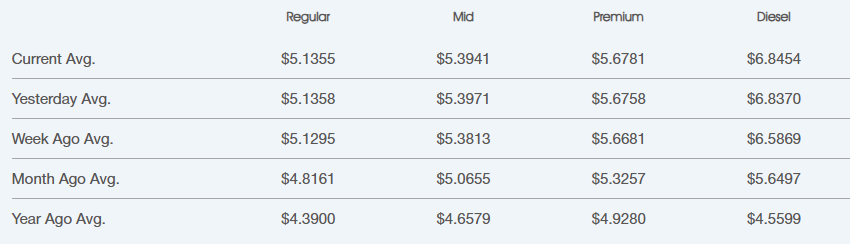
Table of average fuel prices by type (Regular, Mid, Premium, Diesel) with current, yesterday, week, month, and year averages.

Fuel Market News

Fuel prices jumped once again this past week. The Olympic Pipeline, which supplies most of the PNW, shut down for maintenance on August 28th and is still down till the end of the week. This caused issues for the supply of both gas and diesel in the region, which led to the price increases we see.

Drivers in the Portland area are still seeing gas around $4.97/gal & diesel over $5.86/gal. In Seattle, gas prices are $5.55/gal with diesel hovering around $6.45/gal.
The Trump admin has announced a seizure and control of over 65 billion barrels of Venezuelan oil. No, this won’t lower gas prices tomorrow. This is a development that will take over 25 years to fully complete and optimize. Not to mention Venezuelan oil is a very thick blend of crude oil and will take intensive refining to be usable.
WTI Crude is trading around $91.18/barrel as of the 31st.

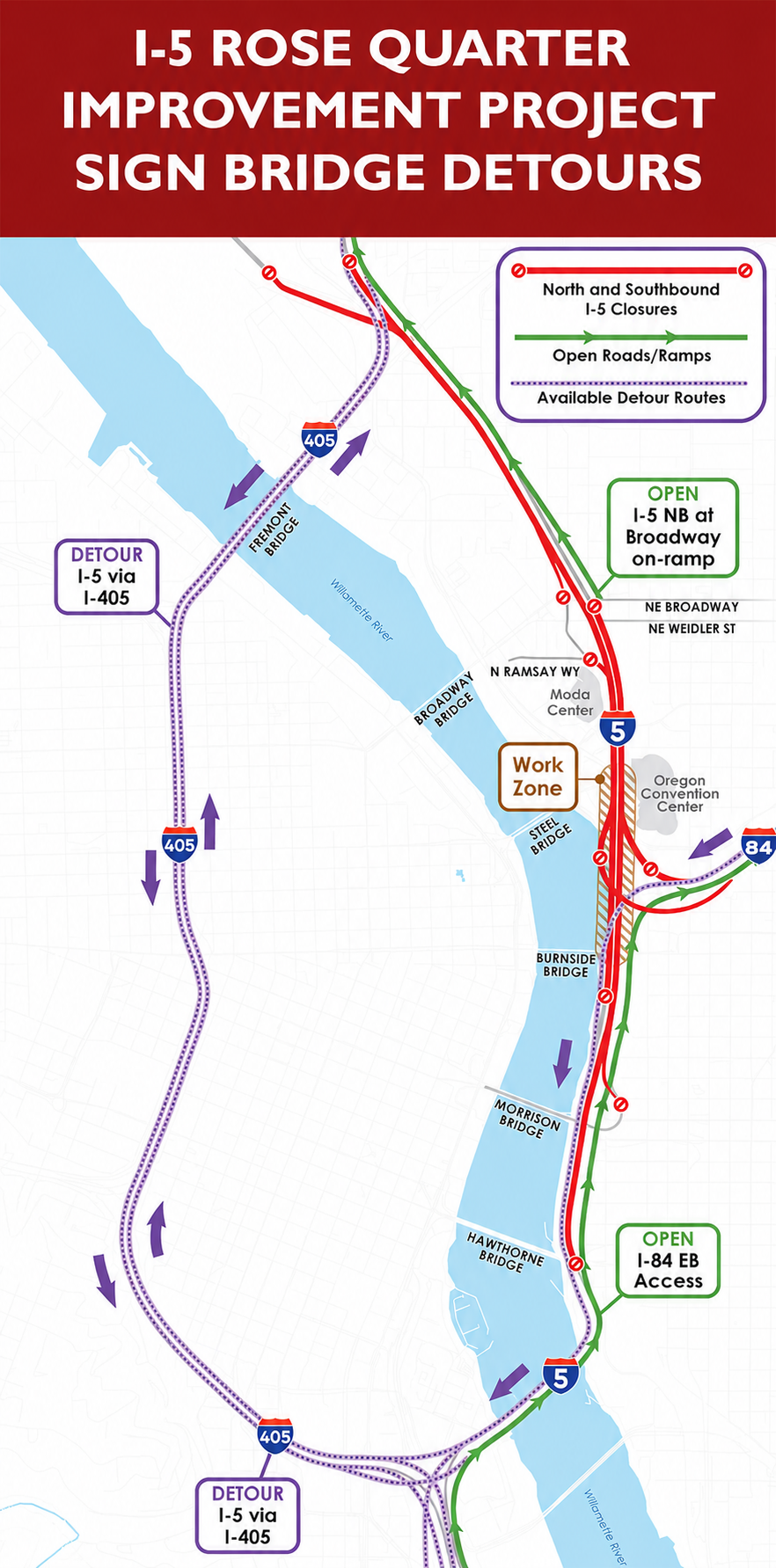
The 1-5 Corridor will have a planned 5-7 week shutdown of the 1-5 Corridor next to the Moda Center. This will begin September 9th 2026. We will provide more detail on this in the next Fuel Market Report. To learn more, go to Oregon – DOT.

fuel-market-report-star-oilco-5-18-24

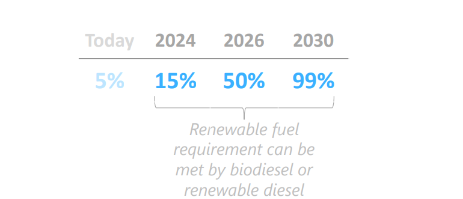
Important Note: Per the City Of Portland, “Distributors in the City of Portland are required to meet the minimum biofuel content requirements for all fuel they distribute beginning on May 15, 2024. All diesel fuel distributed to retail stations, non-retail dealers, or wholesale purchaser-consumers must include a minimum of 15% biofuel content, from either renewable diesel or biodiesel. This requirement increases to 50% on May 15, 2026, and 99% on May 15, 2030”.

Crude oil is currently hovering, at a current price of  $91.18/barrel.

Crude oil is the main ingredient for gasoline and diesel. Per AAA, on average about 50% of what you pay at the pump is the price of crude oil, breaking down as 25% refining, 11% distribution & marketing, and 14% taxes – a helpful breakdown for consumers wondering why they are paying the prices that they pay. Crude Oil is currently trading at $91.18/barrel compared to $88.40/barrel last week and $78 a year ago.

It’s essential to recognize that fuel prices result from a complex interplay of the factors mentioned above and other regional factors. Additionally, prices may vary by specific regions within Oregon and Washington. For the most precise and up-to-date information on fuel prices and the causes for these price changes within your area, use the links below for AAA & GasBuddy.

If you have any questions, feel free to contact Star Oilco and speak to one of our fuel market advisors to discuss how the market can impact your business.

Set up your R99 Mobile Fueling Onsite Service in Portland Today Including Dyed Untaxed R99.

Give Us A Call Today

For other news in the fuel market:

https://gasprices.aaa.com/?state=OR

https://www.gasbuddy.com/charts

Join the Fuel Market Report newsletter for your weekly fill of updates!

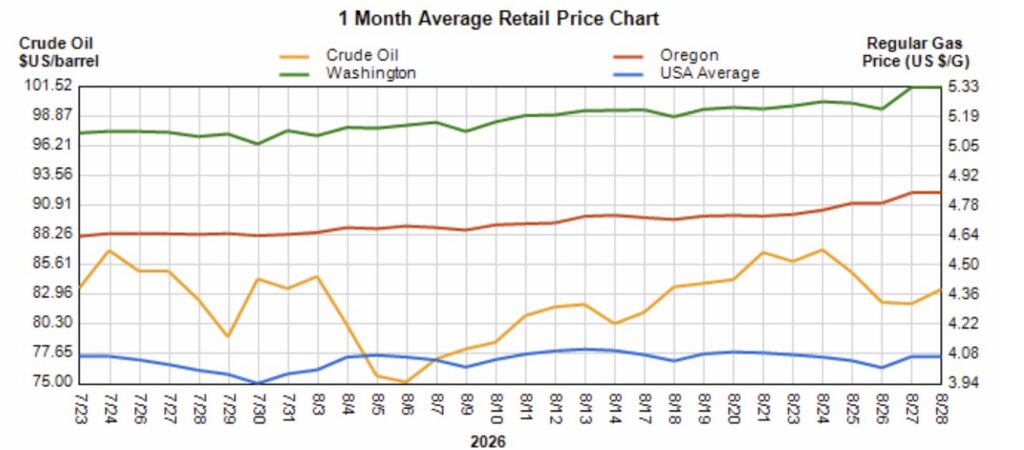
Weekly Fuel Market Report – Aug 16th – Aug 22nd, 2026 150 150 Star Oilco

Weekly Fuel Market Report – Aug 16th – Aug 22nd, 2026

Fuel Market Report by Star Oilco Banner
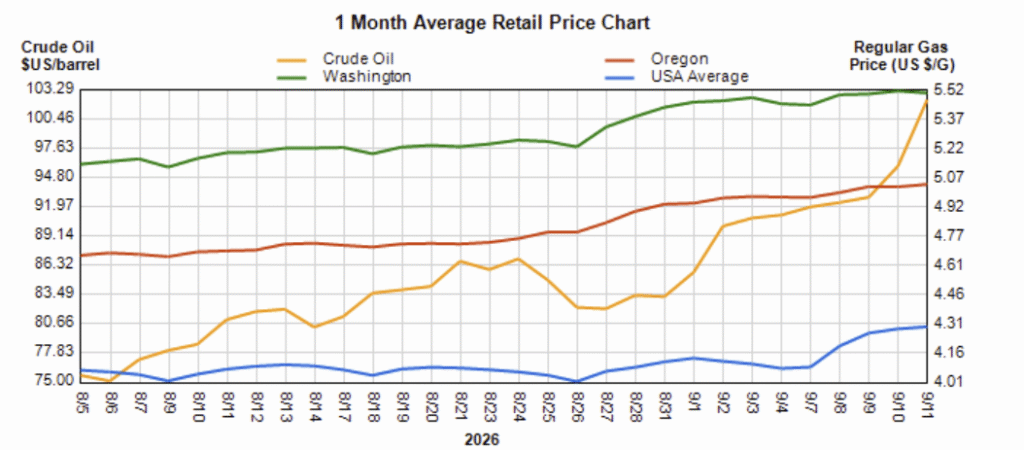
Line chart titled '1 Month Average Retail Price Chart' showing trends in crude oil price per barrel and regional gasoline prices (Washington, Oregon) plus USA average price in 2026.

Did You Know That R99 Is The Same Cost As Diesel Currently?

Call to set up R99 Mobile Fueling Onsite Service in Portland at the same cost of retail diesel. Dyed untaxed R99 is also available. Give us a call today to schedule your delivery.

Wholesale Price Average 8/22/26

Wholesale LowWholesale Avg
E10$3.48$3.57
B5$4.44$4.55
B20$4.39$4.49
R99$4.36$4.47

Average Retail Prices 8/22/26

NationalOregonWashington
Regular Gasoline$4.09$4.77$5.27
Diesel$5.62$5.67$6.34

Taxes

FederalState: ORLocalState: WA
Gas$0.184$0.40$0-.13$0.554
Diesel$0.244$0.40$0-.13$0.584

Portland Retail Fuel Price Variance

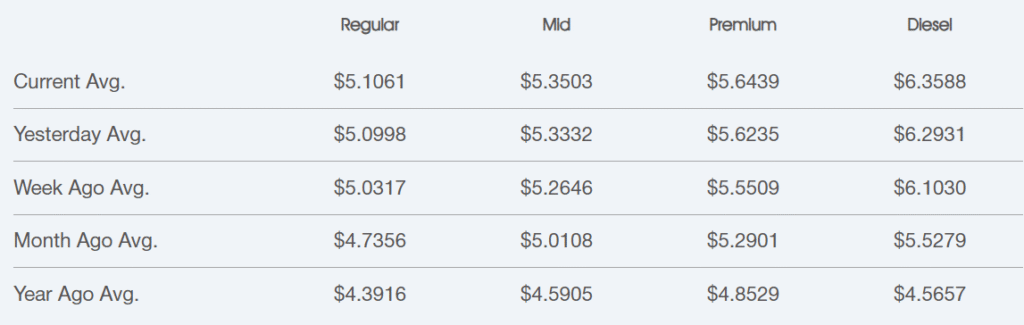
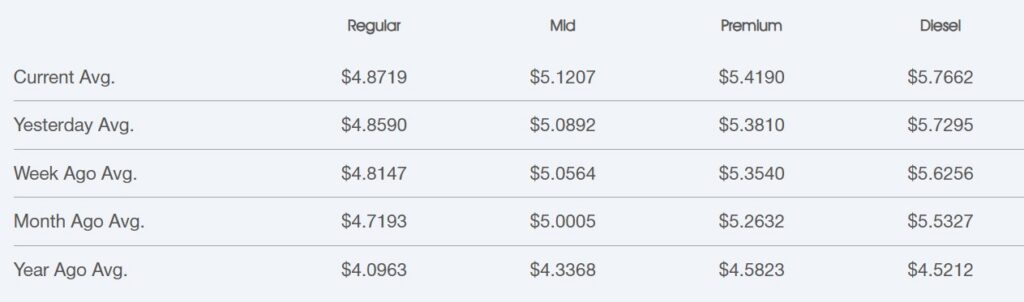
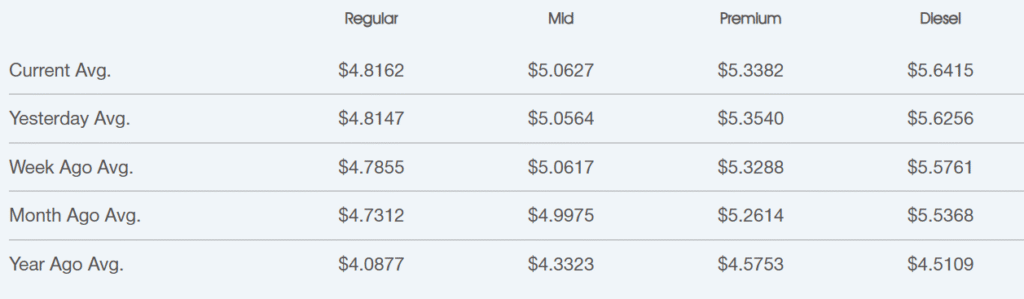
Table of average fuel prices by type: Regular $4.8162, Mid $5.0627, Premium $5.3382, Diesel $5.6415 (Current Avg).

Fuel Market News

Fuel prices took a significant jump yet again this past week, with prices soaring over $0.30/gal higher than they were the week before. These price jumps were noticed across the board, as both the retail and wholesale rack markets saw significant price jumps. Part of this is due to the shortage of gasoline in the PNW, which has caused gas prices to climb over the last two weeks.

Drivers in the Portland area are still seeing gas around $4.93/gal & diesel over $5.61/gal. In Seattle, gas prices are $5.55/gal with diesel hovering around $6.55/gal. 
The Trump admin has announced an “Economic D-Day” against Iran (after spending over $50 billion of US taxpayer dollars on this war), which will impose new sanctions and restrictions to Iran, as negotiations have ceased to continue between the U.S & Iran. So much remains unclear to the US public about the Iran war, such as why Jared Kushner, a non-elected private citizen and son-in-law of Donald Trump, is serving as a negotiator for the U.S in conversation with Iran.

WTI Crude is trading around $88.40/barrel as of the 25th. There have been no newly announced military strikes occurring within the last 17 days between the U.S & Iran. The 1-5 Corridor will have a planned 10 – 15 week shutdown of the 1-5 Corridor next to the Moda Center. This will begin September 9th 2026. We will provide more detail on this in the next Fuel Market Report. To learn more, go to Oregon – DOT.

fuel-market-report-star-oilco-5-18-24

Important Note: Per the City Of Portland, “Distributors in the City of Portland are required to meet the minimum biofuel content requirements for all fuel they distribute beginning on May 15, 2024. All diesel fuel distributed to retail stations, non-retail dealers, or wholesale purchaser-consumers must include a minimum of 15% biofuel content, from either renewable diesel or biodiesel. This requirement increases to 50% on May 15, 2026, and 99% on May 15, 2030”.

Crude oil is currently hovering, at a current price of  $88.40/barrel.

Crude oil is the main ingredient for gasoline and diesel. Per AAA, on average about 50% of what you pay at the pump is the price of crude oil, breaking down as 25% refining, 11% distribution & marketing, and 14% taxes – a helpful breakdown for consumers wondering why they are paying the prices that they pay. Crude Oil is currently trading at $88.40/barrel compared to $85.37/barrel last week and $74 a year ago.

It’s essential to recognize that fuel prices result from a complex interplay of the factors mentioned above and other regional factors. Additionally, prices may vary by specific regions within Oregon and Washington. For the most precise and up-to-date information on fuel prices and the causes for these price changes within your area, use the links below for AAA & GasBuddy.

If you have any questions, feel free to contact Star Oilco and speak to one of our fuel market advisors to discuss how the market can impact your business.

Set up your R99 Mobile Fueling Onsite Service in Portland Today Including Dyed Untaxed R99.

Give Us A Call Today

For other news in the fuel market:

https://gasprices.aaa.com/?state=OR

https://www.gasbuddy.com/charts

Join the Fuel Market Report newsletter for your weekly fill of updates!

Close-up of golden liquid waves symbolizing fuel energy in motion
Oregon Dyed Diesel Laws: Who Can Use It? 1024 585 Star Oilco

Oregon Dyed Diesel Laws: Who Can Use It?

If you run construction equipment, generators, farm machinery, pumps, or other diesel-powered equipment in Oregon, you may be able to use dyed diesel.

You may also hear it called off-road diesel or red diesel.

The important thing to understand is that dyed diesel is not meant for just any diesel-powered vehicle. Whether you can legally use it depends on where and how the fuel is being used.

In Oregon, diesel used to power vehicles traveling on public roads is generally subject to fuel taxes. Dyed diesel is intended for qualifying off-road and other nontaxable uses.

What Is Dyed Diesel?

Dyed diesel is diesel fuel that contains a red dye to identify it as fuel intended for qualifying nontaxable uses.

The red color does not mean the fuel is completely different from regular diesel. The dye is there so regulators can tell the difference between fuel sold for qualifying off-road use and clear diesel intended for highway vehicles.

You may also hear dyed diesel called:

  • Red diesel
  • Off-road diesel
  • Dyed off-road diesel
  • Dyed fuel
  • Non-highway diesel
Hawthorne Bridge over the Willamette River in Portland, Oregon

For Oregon businesses, the most important question is not simply what kind of equipment you own. What matters is how that equipment is being used.

Why Is Dyed Diesel Red?

The red dye makes the fuel easy to identify.

Federal fuel-tax rules require qualifying untaxed diesel to contain dye so regulators can distinguish it from fuel intended for taxable highway use. That is why using dyed diesel in a highway vehicle is not simply a matter of trying to save money on fuel.

If fuel is inspected, the red dye can show that dyed diesel was placed in a vehicle or tank where it may not legally belong.

Who Can Legally Use Dyed Diesel in Oregon?

Dyed diesel is commonly used in equipment that operates off public roads or is used for another qualifying nontaxable purpose.
Some of the most common examples include construction equipment, generators, agricultural machinery, industrial equipment, and other stationary diesel-powered equipment.

Stationary and backup generators are another common use for dyed diesel.

Examples include:

  • Emergency generators
  • Commercial backup generators
  • Construction-site generators
  • Temporary power systems
  • Data and communications facilities

Because generators use diesel to produce electricity rather than move a vehicle down a public road, they can generally qualify for dyed diesel.

Construction companies are some of the biggest users of dyed diesel.

Common equipment includes:

  • Excavators
  • Bulldozers
  • Loaders
  • Cranes
  • Pavers
  • Compressors
  • Skid steers
  • Trenchers
  • Other non-highway construction equipment

If the equipment is working on a jobsite and is not being used as a normal highway vehicle, dyed diesel may be the right fuel.

Star Oilco regularly provides diesel fueling for construction projects throughout the Portland area, including direct-to-equipment fueling and onsite fuel tanks.

Many types of farm equipment may also qualify for dyed diesel.

Examples include:

  • Tractors
  • Combines
  • Harvesting equipment
  • Irrigation equipment
  • Other agricultural machinery

Oregon also has specific rules for certain farm tractors and implements of husbandry that may occasionally travel on public roads.

If your farm equipment regularly travels on public roads, it is a good idea to check the current Oregon rules before deciding which fuel to use.

Many industrial businesses use diesel engines that never operate as normal highway vehicles.

Examples can include:

  • Pumps
  • Compressors
  • Stationary engines
  • Material-handling equipment
  • Industrial machinery
  • Certain yard equipment

These types of applications may be able to use dyed diesel when they meet the requirements for nontaxable use.

Diesel is also used for some heating systems and other stationary applications.

Again, the main issue is how the fuel is being used. Dyed diesel must be used for a qualifying purpose and should not be treated as a cheaper alternative to highway diesel.

What Happens If You Use Dyed Diesel Illegally?

Using dyed diesel for a taxable highway purpose can result in serious penalties.

Federal penalties for knowingly misusing dyed diesel can start at the greater of $1,000 or $10 per gallon of fuel involved, depending on the situation.

Additional taxes and penalties may also apply.

For a business, the potential savings from illegally using dyed diesel in highway vehicles are nowhere near worth the risk.

A good rule for your employees is simple:

Use dyed diesel in qualifying off-road equipment and clear diesel in vehicles that operate on public roads.

Businesses that use both types of fuel should also have a clear fueling process so employees know which fuel belongs in which piece of equipment.

This is one of the most common questions we hear

Can You Use Dyed Diesel in a Truck in Oregon?

The short answer is that you should not put dyed diesel into a normal truck that is being driven on public roads.

That includes work trucks.

Just because a pickup or service truck belongs to a construction company, farm, or industrial business does not automatically mean it can use dyed diesel.

A simple way to think about it is:

Excavator working on a construction site:

Dyed diesel may be appropriate.

Pickup truck driving employees to the construction site:

Highway diesel rules apply.

Stationary generator at the jobsite:

Dyed diesel may be appropriate.

Dump truck driving on Oregon public highways:

Highway diesel rules apply.

A construction company can easily need both dyed diesel and clear diesel on the same jobsite.

Can Equipment Using Dyed Diesel Ever Cross a Public Road?

Sometimes the answer is more complicated than a simple yes or no.

Certain pieces of equipment may occasionally cross or travel a short distance on a public road without being treated the same way as a normal highway vehicle.

Oregon has specific rules covering certain farm tractors and implements of husbandry that are only occasionally operated or moved over public highways.

That does not mean every piece of off-road equipment can travel on public roads while using dyed diesel.

If your equipment regularly operates on public roads, or you are not sure whether your situation qualifies, check with the Oregon Department of Transportation or a qualified tax professional before using dyed fuel.

Red dyed diesel fuel being poured into a clear sample container

Is Dyed Diesel Cheaper Than Clear Diesel in Oregon?

Usually, yes.

Dyed diesel is often less expensive because certain highway-related fuel taxes do not apply when the fuel is being used for a qualifying purpose.

The actual price difference will depend on current fuel prices, taxes, delivery location, fuel specifications, and the amount of fuel being delivered.

For companies that use large amounts of diesel in off-road equipment, the savings can add up quickly.

The important part is making sure the equipment actually qualifies for dyed diesel.

In the quest for a greener future, renewable diesel has firmly taken the lead. Its remarkable reduction in emissions, better fuel economy, and seamless integration into existing diesel infrastructure make it the go-to choice for heavy-duty truck operators. While standard biodiesel has made commendable progress in reducing emissions, renewable diesel emerges as the winner in the arena of cleaner and more efficient fuels. 

The studies quoted in this blog are just the tip of the iceberg, illustrating the overwhelming evidence in favor of renewable diesel. As we move forward in our pursuit of sustainable transportation, it’s clear that renewable diesel will play a pivotal role in driving us toward a cleaner, more environmentally friendly tomorrow. 

Is Dyed Diesel the Same as Off-Road Diesel?

In everyday conversation, yes.

The terms dyed diesel, red diesel, and off-road diesel are commonly used to describe diesel fuel that has been dyed red and is intended for qualifying nontaxable uses.

That said, there can still be differences between the actual fuel products available.

Depending on your operation, you may need to think about:

  • Diesel grade
  • Biodiesel content
  • Renewable diesel content
  • Seasonal treatment
  • Cold-weather performance
  • Storage
  • Additives
  • Equipment requirements

If you are buying fuel in bulk, it is worth talking with your supplier about both the legal use of the fuel and the type of diesel that makes the most sense for your equipment.

In the quest for a greener future, renewable diesel has firmly taken the lead. Its remarkable reduction in emissions, better fuel economy, and seamless integration into existing diesel infrastructure make it the go-to choice for heavy-duty truck operators. While standard biodiesel has made commendable progress in reducing emissions, renewable diesel emerges as the winner in the arena of cleaner and more efficient fuels. 

The studies quoted in this blog are just the tip of the iceberg, illustrating the overwhelming evidence in favor of renewable diesel. As we move forward in our pursuit of sustainable transportation, it’s clear that renewable diesel will play a pivotal role in driving us toward a cleaner, more environmentally friendly tomorrow. 

Do I Need a Permit to Buy Dyed Diesel in Oregon?

It depends on what your business is doing with the fuel.

Oregon has different fuel-tax rules for fuel users, sellers, dealers, distributors, and other businesses involved in the fuel supply chain.

A contractor buying dyed diesel for equipment at a jobsite is not necessarily subject to the same requirements as a company that distributes or resells fuel.

If you are unsure whether your business needs a license, registration, or specific tax reporting, check with the Oregon Department of Transportation Fuels Tax Group or your tax professional.

How Should Businesses Keep Dyed and Clear Diesel Separate?

If your company uses both highway vehicles and off-road equipment, it is important to keep your fueling process organized.

A few simple steps can help:

  • Clearly label dyed-diesel storage tanks
  • Clearly label pumps and dispensing equipment
  • Train employees on which equipment can use dyed diesel
  • Keep delivery and fueling records
  • Separate dyed and clear diesel tanks when possible
  • Limit access to onsite fuel
  • Work with a fuel supplier that understands commercial and construction fueling

These steps can help prevent accidental misfueling and make it easier for employees to know which fuel they should be using.

Dyed Diesel Delivery in Portland and Northwest Oregon

Star Oilco supplies businesses throughout the Portland metro area with dyed off-road diesel and commercial fuel delivery.

We fuel construction sites, generators, industrial equipment, and bulk fuel tanks. We also work with businesses that need both dyed diesel for equipment and clear diesel for highway vehicles.

If you need fuel delivered directly into your equipment or want an onsite fuel tank for an ongoing project, we can help set up a fueling plan that fits the way your operation works.

Need Dyed Diesel for Your Oregon Operation?

Not sure whether your equipment should be using dyed diesel or clear diesel? Talk with Star Oilco about what you are fueling, where the equipment operates, and how much diesel you use.

Common Questions About Dyed Diesel in Oregon

Yes, qualifying construction equipment operating off public roads can generally use dyed diesel. Excavators, loaders, generators, and similar jobsite equipment are common examples.

If the pickup is being driven on public roads, you generally should not use dyed diesel in it. A work truck is still a highway vehicle when it is traveling on public roads.

Yes. Stationary and backup generators are common uses for dyed diesel because the fuel is being used to produce power rather than propel a highway vehicle.

Yes, qualifying agricultural and off-road farm equipment can use dyed diesel. Some situations involving farm equipment traveling on public roads have additional rules, so it is worth checking current Oregon requirements if you are unsure.

No. In this context, red diesel is simply another common name for dyed diesel.

Often, but private property by itself is not the only thing that determines whether the fuel qualifies.

The type of equipment and how it is being used also matter. If a vehicle operates both on private property and public roads, it is a good idea to confirm the rules before using dyed diesel.

Sign up for our newsletter to stay up to date

Name(Required)

This page provides general information about dyed diesel and fuel-tax rules. It is not tax or legal advice. Rules can depend on the specific equipment and how it is being used. For questions about your specific situation, consult current Oregon Department of Transportation guidance, IRS guidance, or a qualified tax professional.
Weekly Fuel Market Report – Aug 9th – Aug 15th, 2026 150 150 Star Oilco

Weekly Fuel Market Report – Aug 9th – Aug 15th, 2026

Fuel Market Report by Star Oilco Banner
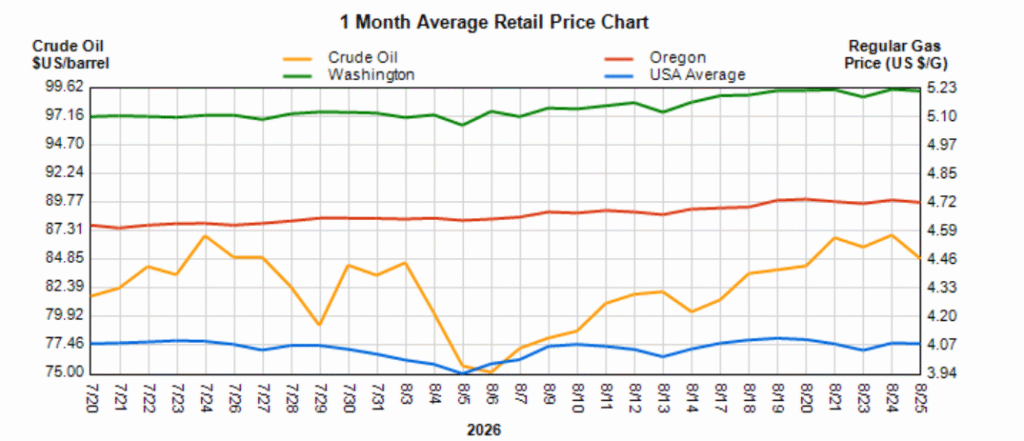
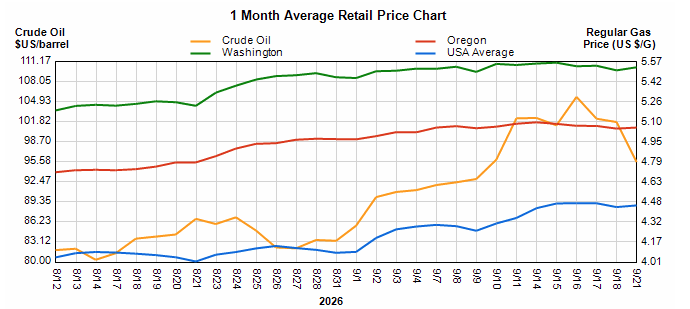
Oregon and Washington gas prices compared with U.S. average and crude oil prices, July to August 2026

Did You Know That R99 Is The Same Cost As Diesel Currently?

Call to set up R99 Mobile Fueling Onsite Service in Portland at the same cost of retail diesel. Dyed untaxed R99 is also available. Give us a call today to schedule your delivery.

Wholesale Price Average 8/15/26

Wholesale LowWholesale Avg
E10$3.32$3.48
B5$4.21$4.33
B20$4.15$4.26
R99$4.04$4.16

Average Retail Prices 8/15/26

NationalOregonWashington
Regular Gasoline$4.07$4.71$5.19
Diesel$5.44$5.55$6.21

Taxes

FederalState: ORLocalState: WA
Gas$0.184$0.40$0-.13$0.554
Diesel$0.244$0.40$0-.13$0.584

Portland Retail Fuel Price Variance

Average Oregon fuel prices for regular, midgrade, premium gasoline and diesel, August 2026

Fuel Market News

Fuel prices were up significantly this past week with the national average price for diesel jumping over $0.14/gal. This past week brought an inversion of price movement on the wholesale market . as gas prices dropped about $0.08/gal while diesel prices jumped over $0.42/gal. These surprisingly did not hit the retail market very hard as retail prices move less than $0.10/gal. Drivers in the Portland area are still seeing gas around $4.85/gal & diesel over $5.65/gal. In Seattle, gas prices are $5.45/gal with diesel hovering around $6.45/gal. 

WTI Crude is trading around $85.37/barrel as of the 17th. There have been no newly announced military strikes occurring within the last 17 days between the U.S & Iran. Although much still remains unclear about the timeline of the war, there have been no new strikes in the last two weeks. 

The 1-5 Corridor will have a planned 10 – 15 week shut down of the 1-5 Corridor next to the Moda Center. This will begin September 9th 2026. We will provide more detail on this in the next Fuel market Report. To learn more go to Oregon – DOT.

fuel-market-report-star-oilco-5-18-24

Important Note: Per the City Of Portland, “Distributors in the City of Portland are required to meet the minimum biofuel content requirements for all fuel they distribute beginning on May 15, 2024. All diesel fuel distributed to retail stations, non-retail dealers, or wholesale purchaser-consumers must include a minimum of 15% biofuel content, from either renewable diesel or biodiesel. This requirement increases to 50% on May 15, 2026, and 99% on May 15, 2030”.

Crude oil is currently hovering, at a current price of  $85.37/barrel.

Crude oil is the main ingredient for gasoline and diesel. Per AAA, on average about 50% of what you pay at the pump is the price of crude oil, breaking down as 25% refining, 11% distribution & marketing, and 14% taxes – a helpful breakdown for consumers wondering why they are paying the prices that they pay. Crude Oil is currently trading at $85.37/barrel compared to $80.41/barrel last week and $78 a year ago.

It’s essential to recognize that fuel prices result from a complex interplay of the factors mentioned above and other regional factors. Additionally, prices may vary by specific regions within Oregon and Washington. For the most precise and up-to-date information on fuel prices and the causes for these price changes within your area, use the links below for AAA & GasBuddy.

If you have any questions, feel free to contact Star Oilco and speak to one of our fuel market advisors to discuss how the market can impact your business.

Set up your R99 Mobile Fueling Onsite Service in Portland Today Including Dyed Untaxed R99.

Give Us A Call Today

For other news in the fuel market:

https://gasprices.aaa.com/?state=OR

https://www.gasbuddy.com/charts

Join the Fuel Market Report newsletter for your weekly fill of updates!

Icons representing fuel, savings, and driver control for fleet card security
Upgrade your Fleet Card’s Security Features 1024 653 Star Oilco

Upgrade your Fleet Card’s Security Features

Human Resource strategies to stop employees from stealing gas and diesel in your  business with these best practices.


Upgrade the security features on your Pacific Pride fuel cards with Star Oilco.

Are you looking to use a corporate fleet card to simplify your fuel buying while also knocking out your exposure to employee gas theft?
Star Oilco can make that easy for you.

Regardless of what system you choose, there are some organizational best practices, that when implemented, will be self-reinforcing in your organization. Simple little changes to how you approach fuel cards will greatly reduce any opportunity for theft.

Whether you use a Pacific Pride, Voyager, WEX, Comdata, Fuelman, or CFN corporate fleet card, you can take inventory of what you are currently doing and upgrade that process with these best practices.

Fleet Card Best Practice #1: Your current vendor should be able to assist you with securing your fleet card.  Call your current card provider and ask for a list of every active card, the last time it was used, the PINs associated with these cards, and security features associated. Check these against your next bill to see what cards aren’t being used.  Turn off a card not being used.

Fleet Card Best Practice #2: Annually take inventory of what cards you have and who is using them. Line up this list of active cards with your employees and make sure there isn’t a lost card out there.  Often a card policy implemented by Human Resources or your Dispatcher is a good way to track what employees have what cards.

On a regular basis, pass a clip board around asking each employee with a fleet card to confirm they still have that card and initial a confirmation that the card is still in their possession.  You would be surprised how individual cards can float between employees as it is easier than asking for a new card.

Fleet Card Best Practice #3: Audit your transactions regularly. This is a great project for your Account’s Payable to look through. Check against the card list of active cards looking for transactions that occur outside of normal business hours and days. Look for locations outside of your service area as well.  Also look for cards with more than one transaction in a day or large volumes as often that’s theft.

Fleet Card Best Practice #4: Put your Fleet Cards on the key ring dispatched with the vehicle, not with the driver. To limit a risk of a stolen card, restrict card ownership to management and maintenance. Everyone else should have cards directly connected with a vehicles license plate, so if that card goes missing it is obvious.

Fleet Card Best Practice #5: Program your cards for the vehicles they are attached to. You do this by connecting the card to the vehicle with a key ring. Then program the Fleet Card to only allow a specific fuel for that vehicle (regular, premium or diesel), limit the fill volume needed for that vehicle’s tank, and also limit the times of day that vehicle can get fuel. This reduces the opportunity for theft to exceed a small minimum and also makes theft obvious when the limits are hit.

Fleet Card Best Practice #6: it’s the 21st Century so manage in real time.  Make sure your Fleet Card provider can send an email to your Dispatch or fleet management in real time as the fuel cards are being used. Mistakes relating to efficiency or theft will be far more obvious and trainable if the transaction is observed the day of rather than a week. Instant feedback and communication is critical to change bad behavior of driver’s who mean to do well but may just have mad ea simple mistake.

Fleet Card Best Practice #7: Buy fuel by your vehicle not by an individual.  Move your Fleet Card program to a “Floating PIN” system. All modern Fleet Cards should offer this option. It enables you to attach the Fleet Card to the vehicle (all costs are tracked by the vehicle number and/or license plate on your invoices) and provide a unique and secret PIN to each of your driving employees.

If they use the card, their name appears on the bill next to their transaction. If PINs are kept secret and this is enforced, any theft or inappropriate fuel usage will be extremely obvious and accountable.

Fleet Card Best Practice #8: Adopt a “No Tolerance Fuel Theft Policy” as part of your hiring process, as well as every time you replace or issue new Fleet Cards. This is a policy managed by your Human Resources or Driver Compliance department. It is a form disclosing that any fuel cards or PINs related with cards are confidential and assigned to a person or vehicle.

Any use of a PIN will be the responsibility of the person who that PIN is associated with. A personal private PIN is their responsibility. If it is used, they are responsible and any observed fuel theft will be a first-time fire/termination offense. PINs are to be kept secret and if the PIN is known by someone else, it is their responsibility to let management know and get that personal PIN changed.

Fleet Card Best Practice #9: Negotiate a Cost-Plus basis for your fleet fueling costs. You should be able to have a frank conversation with your commercial fueling provider about where prices come from and how much margin they charge you. In many markets, fuel providers can even get a wholesale cost plus basis for fuel that beats the retail street mark ups. Pacific Pride and CFN stand alone commercial cardlocks are focused on this type of need. Often the savings for diesel customers is very substantial due to this model of pricing.

Fleet Card Best Practice #10: Negotiate the terms you need for the way you buy fuel. If you have a frank conversation about the terms and costs related with buying fuel, you’ll have more options that are available but not advertised. Industry standard for fuel sellers is either ten day terms with twice monthly or monthly billing. If you have the ability to pay faster, often deeper discounts are provided.

For extremely large customers daily billing could net thousands of dollars in savings a month. For operations relying on 45-day fuel charge reimbursements, talking to a fuel vendor about matching your fuel bill with a fleet’s Accounts Receivable can prevent huge cash-flow crunches.

Need to secure your fleet from fuel theft?

Call Star Oilco, we can make it easy.

Star Oilco can help you field all of these Best Practices. Our motto is “Keep it Simple” and we are there to make this easy. Feel free to reach out and see what Star Oilco can do for your fleet to upgrade it’s fleet fueling security.

To download a white paper on these Pacific Pride fuel card security feature best practices go HERE to our Stop Fuel Theft page.


Contact Form

  • This field is for validation purposes and should be left unchanged.

Star Oilco technician testing off-road diesel fuel quality with a funnel and filter on-site in Portland OR
Off-Road Diesel – When To Use And The Benefits 1024 768 Star Oilco

Off-Road Diesel – When To Use And The Benefits

What are the benefits and when can you use off-road diesel 

Off-road diesel excels with a higher cetane rating, enhancing engine performance and offering cost savings without taxes. However, it’s strictly for off-road vehicles like tractors and construction machinery. Using it in regular on-road cars is illegal, leading to fines and potential imprisonment. 

Green fuel nozzle for off-road diesel fueling

Advantages of off-road diesel 

Higher Cetane Rating: Igniting Efficiency 

Off-road diesel takes the lead with a significantly higher cetane rating. With quicker ignition, 20% fewer emissions, and an impressive 15% reduction in engine downtime. It’s not just fuel; it’s a performance booster. 

Engine Performance and Durability 

Crafted for off-road adventures, this fuel has specialized additives that provide extra lubrication and deliver approximately 12% improvement in engine efficiency. Better performance isn’t just a promise; it’s a measurable reality with a 10% boost in fuel economy. 

No Tax, More Savings 

On-road diesel carries higher taxes, supporting highway maintenance. The federal tax is the same across the U.S., but states can add charges based on volume or spending. In contrast, off-road fuel sidesteps federal and state excise taxes due to non-road use, as it causes no wear and tear on the roads, saving you more with each gallon. 

Cost-Effective Fueling 

Brace yourself for the financial magic – lower tax rates. Off-road diesel translates into tangible savings, averaging 25 to 50 cents per gallon. For businesses on the off-highway path, it’s not just about fuel; it’s about a budget-friendly journey with an estimated annual savings of $5,000 to $10,000. 

Legal Ease: Staying Compliant 

Dyed in red for a reason, off-road diesel isn’t just a visual standout; it’s a regulatory lifesaver. If you follow standard rules, avoid penalties, choose a fuel that aligns with the law while boasting a 0% penalty rate for unauthorized use. It’s your ticket to smooth, trouble-free operations. 

Dyed Diesel: A Dual Role in Heating 

Expand the use of dyed diesel beyond the road. If your furnace can run on heating oil, embrace dyed diesel for a potential 20% savings on heating costs. It’s not just a fuel choice; it’s a strategy for financial warmth. 

Off-road vehicle tire tracks in remote open terrain

On-Road Diesel vs Off-Road Diesel: Key Differences 

Let’s simplify the diesel dilemma. Both on-road and off-road options share the same chemical makeup, but here’s the twist.

Legal Roads: 

On-road Diesel: Legal for road vehicles, dispensed at gas stations. 

Off-road Diesel: Reserved for non-road machines (tractors, generators).  

Legal Boundaries: 

On-road Diesel: Mandatory for licensed road vehicles in the U.S. 

Off-road Diesel: Illegal for on-road vehicles; hefty fines ($100 to more than $1,000 for one gallon) for misuse, or you may lose your job. 

Color Code: 

On-road Diesel: Clear, available at local gas stations, often called clean or green fuel due to eco-friendliness. 

Off-road Diesel: Red-tinted, dyed for off-road identification. 

Sulfur Content: 

On-road Diesel: Adheres to low sulfur content standards set by the EPA ( (15 ppm sulfur). 

Off-road Diesel is intended for off-road machinery and may have a higher sulfur content (maximum 3000-5000 mg/kg). 

Tax Terrain: 

On-road Diesel: Subject to state excise and federal taxes, generally pricier. 

Off-road Diesel: Tax-exempt, cost-effective for industries like construction and agriculture. 

Availability Channels: 

On-road Diesel: Available for purchase at gas stations. 

Off-road Diesel: Sold through bulk distributors for industrial use. 

Diesel fuel flowing into a dark reflective liquid surface

Off-road Diesel: Who Qualifies? 

Off-road diesel isn’t for everyone, but it could be your fuel hero if you’re in specific industries. 

Who Can Use? 

  • Construction Industry: Heavy-duty champions like cranes, loaders, and excavators 
  • Agriculture Realm: From tractors to harvesters, it fuels the farm force. 
  • Specialty Equipment: Generators, heaters, and more, amplifying productivity. 

Exceptions: 

  • Separate Tanks for Equipment: If your vehicle has a dedicated tank for extra gear, like in reefer trucks, and it doesn’t power the motor, you’re in. 
  • Emergency Saviors: In state-declared emergencies (severe weather or disasters), using off-road diesel on public roads might get a temporary nod. Rules vary, so check your state’s stance.  

Who Are Not Allowed To Use? 

  • Regular On-road Vehicles: Cars, SUVs, and standard trucks hitting public roads or any vehicle having the license to move on the road. 

Ultimately, on-road powers our daily commute, but off-road, dyed in red, proves the unsung hero for industries, offering substantial savings. Portland’s and Pacific Northwest’s off-road fuel suppliers have trustworthy reputations as fuel suppliers.  

Legal boundaries are crucial – fines loom for misusing off-road diesel. So, whether on legal roads or off, choose wisely, stay compliant, and drive on with informed decisions and smoother rides ahead! 

Sign up to receive our fuel market report for your weekly FILL of updates!

Name